API Security and API Gateway
Why Is API Security Important?
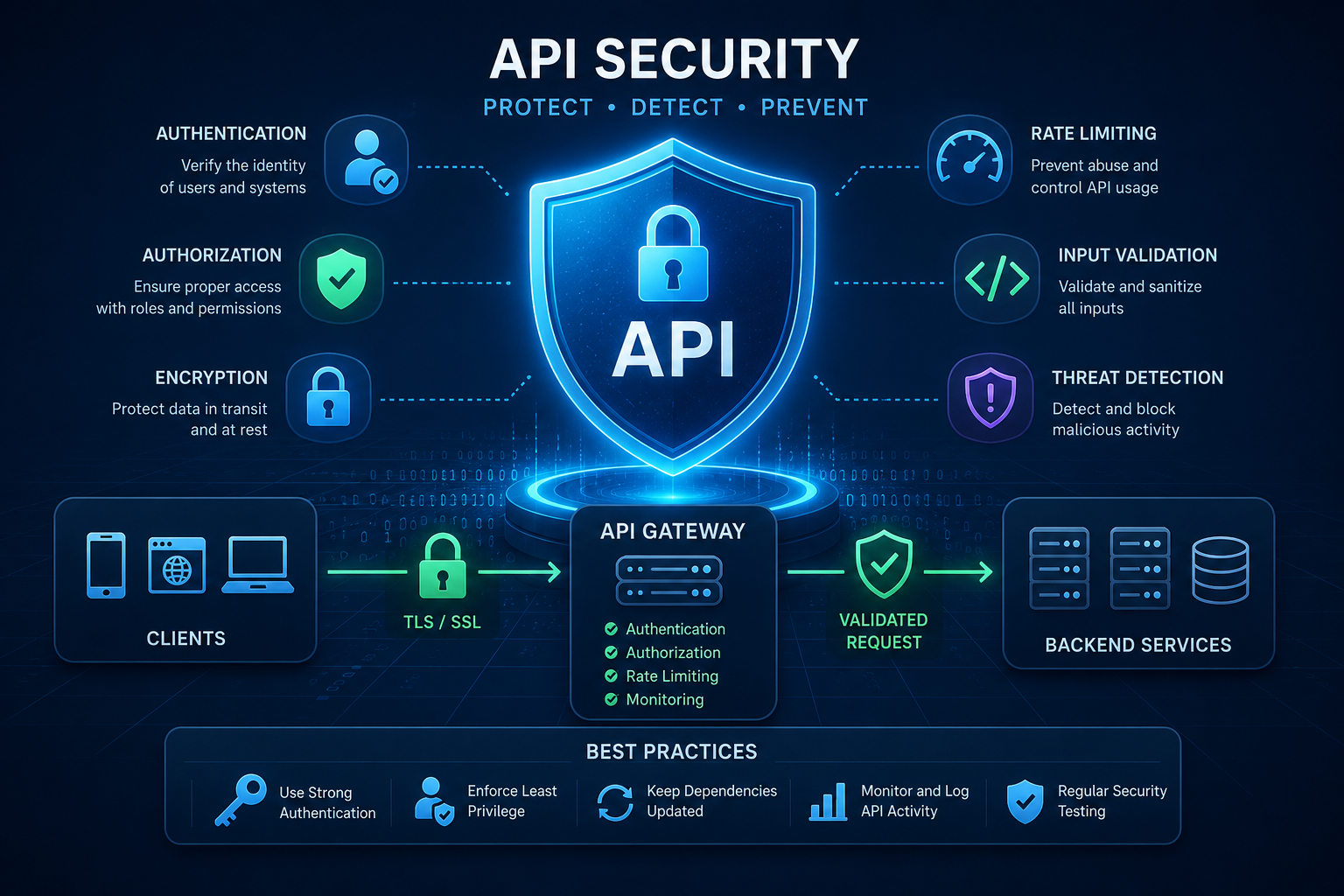
The critical importance of APIs in the information technology sector and their central position in communication between two applications makes them an enormous target for cybercriminals. In modern architectures, APIs handle sensitive data, manage financial transactions, and control critical inter-service functions. For this reason, security breaches at the API layer can lead to major disasters.
If an API is not adequately protected, the following risks may emerge:
- Compromise of sensitive user information
- Unauthorized users gaining access to the system
- Theft of credentials
- Data manipulation
- Making the service unusable by overwhelming it with excessive traffic from non-genuine users (DDoS Attack)
- Misuse of business logic
- Financial and legal losses
Why Are Traditional Security Solutions Insufficient?
While user interaction in standard web applications is largely controlled through the user interface (UI), at the API layer the client directly interfaces with raw data and business logic. Traditional Network Security Firewalls (Firewall) and Web Application Firewalls (WAF) are successful in blocking known attacks such as SQL Injection or Cross-Site-Scripting (XSS) by analyzing HTTP traffic using signature-based analysis.
However, WAFs do not understand the application's business logic. It is impossible using traditional methods to detect whether a user is requesting an object identifier (ID) outside their authority or manipulating an API function. This creates entirely new and exploitation-prone areas for cybercriminals.
While user interaction in standard web applications is largely controlled through the interface (UI), at the API layer the client directly interfaces with data and business logic (business logic). This creates new exploitation areas for cybercriminals.
Ensuring API Security and OWASP
To address these critical risks and discover the best ways to protect APIs, OWASP (Open Web Application Security Project), recognized internationally as the most prestigious authority in information security, published the OWASP API Security TOP 10 list addressing the threat architecture specific to APIs.
Below, we will examine in depth the technical details of these 10 most common vulnerabilities and how they can be proactively addressed through a centralized API Gateway (API Gateway) architecture;
OWASP API Security TOP 10
#1 Broken Object Level Authorization (BOLA)
APIs, by nature, have endpoints that take object identifiers (ID, UUID, etc.) as parameters and return data according to these identifiers. BOLA occurs when a logged-in user can access unauthorized data by changing the object identifier they are requesting (for example, requesting /api/users/102 instead of /api/users/101).
This vulnerability is currently considered one of the most critical API security flaws. Because the attacker does not need to break any security mechanism; simply changing the object identifier in the request is sufficient.
How Does API Gateway Mitigate This Risk?
API Gateway cannot completely prevent BOLA vulnerability on its own. Because the information about whether a resource truly belongs to the relevant user exists only in the application's business logic.
However, API Gateway can significantly hinder such attacks by implementing the following security controls:
- It ensures that only authenticated users can access the API by validating JWT or OAuth2 Access Tokens.
- It reliably forwards user information (Claims) from tokens to Backend services.
- It blocks invalid, expired, or fraudulent tokens before they reach the Backend.
- It facilitates detection of suspicious access attempts by logging requests along with user identity.
- It can restrict rapid requests to different object identifiers by the same user using Rate Limiting policies.
#2 Broken Authentication
Authentication is one of the fundamental pillars of API security. Broken Authentication refers to security vulnerabilities that arise from incorrect or incomplete implementation of mechanisms used to authenticate users. This vulnerability can lead to attackers compromising other users' identities, misusing valid sessions, or gaining unauthorized access to the system.
The most common authentication vulnerabilities are:
- Failure to validate JWT (JSON Web Token) signatures
- Acceptance of expired tokens
- Use of weak or predictable passwords
- Lack of protection against Brute Force attacks
- Insecure storage or transmission of API Keys
- Incorrect implementation of OAuth2 or OpenID Connect configurations
A single error in the authentication mechanism can allow an attacker to access the application as a legitimate user. For this reason, the Authentication process must be managed centrally, consistently, and securely.
How Does API Gateway Mitigate This Risk?
Since API Gateway is the first point of contact for all incoming requests from clients, it can centrally perform authentication operations. Thus, invalid or untrustworthy requests are blocked before reaching Backend services.
API Gateway can provide the following security controls in this regard;
- It validates JWT (JSON Web Token) signatures and rejects forged tokens.
- It controls the token expiration date and blocks requests made with expired tokens.
- It verifies the correctness of the Issuer (iss) and Audience (aud) information within the token.
- It performs centralized authentication by working integrally with OAuth2 and OpenID Connect providers.
- It performs API Key validation allowing only authorized clients to access the API.
- It can work integrally with LDAP, Active Directory, or other identity management systems.
- It can limit multiple login attempts from the same client within a short period using Rate Limiting policies, reducing the impact of Brute Force attacks.
- It logs failed authentication attempts, facilitating security teams' monitoring of suspicious activities.
Implementing authentication centrally on the API Gateway ensures that the same security standards are applied across all services and eliminates the need for each microservice to develop its own authentication mechanism.
#3 Broken Object Property Level Authorization
Broken Object Property Level Authorization (BOPLA) occurs when a client can access object properties (properties) that it should not access or modify. This security vulnerability arises when the API returns the entire object instead of only the fields the client needs, or when the API accepts all fields from the client without validation.
This vulnerability appears in two different scenarios:
- Excessive Data Exposure: The API returns all properties of the object instead of only the fields the client needs. Even if the interface displays only the necessary fields, an attacker can examine the HTTP response to access sensitive data.
- Mass Assignment: When the API directly maps all fields from the client to the data model, an attacker can add normally forbidden fields to the request. For example, critical fields like "role": "admin", "isAdmin": true, or "accountStatus": "ACTIVE" can be updated without authorization.
Such vulnerabilities can lead to privilege escalation, exposure of sensitive data, and violation of the application's business rules.
How Does API Gateway Mitigate This Risk?
-
JSON Schema Validation and XML Schema Validation validate that request bodies comply with pre-defined schemas. This way, requests containing unexpected or unauthorized fields can be rejected before reaching Backend services.
-
JSON Transformation and XML Transformation validate JSON and XML content, preventing corrupted or unexpected data structures from reaching the client.
Through these controls, clients can access only the data they need, while critical fields are largely prevented from being modified or viewed by clients.
#4 Unrestricted Resource Consumption
Modern APIs use system resources such as CPU, memory (RAM), network bandwidth, database connections, and disk to process every request from clients. Allowing uncontrolled consumption of these resources can reduce API performance or render it completely unable to provide service.
Unrestricted Resource Consumption vulnerability arises when the API does not limit the number, size, or processing cost of requests from clients. This situation can occur not only from malicious attacks but also from malfunctioning client applications or unexpected traffic increases.
Using this vulnerability, attackers can;
- Send thousands of HTTP requests per second.
- Transmit very large request bodies to consume server resources.
- Attempt to fetch millions of records in a single request from endpoints without pagination.
- Consume processing capacity by repeatedly making API calls that create intensive database queries.
- Open many connections simultaneously, preventing other users from accessing the service.
As a result of these attacks, API response times may increase, service outages (DoS/DDoS) may occur, and particularly in cloud environments, unexpected infrastructure costs may arise.
How Does API Gateway Mitigate This Risk?
- Rate Limiting (Throttling, Quota, Rate Limit Control List (RLCL)) can limit the number of requests a specific client or group of clients can send within a specified time interval.
- Time Restriction can direct requests to an API within specified hours or prevent them from being directed during specified hours by cutting the request at the Gateway level.
- Max Message Size can reject requests exceeding a specified size.
- Min Message Size can control extremely large responses from being sent to the client.
- Using the Caching mechanism, frequently accessed data can be returned directly from the Gateway, reducing the load on the Backend.
- IP White List allows an API to be consumed only through specific IPs, blocking requests from IPs outside these definitions at the Gateway level.
- Blocked IP List prevents an API from being consumed from specific IPs.
- Monitoring tools available on the Gateway (Uptime Monitor, Anomaly Detector, Alert, etc.) enable real-time detection of unusual traffic increases and execution of actions within the Gateway, such as sending emails, writing to databases, and logging to other structures.
Through these controls, malicious or faulty clients are stopped before consuming resources, and Backend services deal only with valid requests that need to be processed.
#5 Broken Function Level Authorization (BFLA)
Broken Function Level Authorization (BFLA) is a security vulnerability that arises when authorization controls are incomplete or incorrectly implemented, even though users should only be able to access API functions they are authorized to use.
This vulnerability usually arises from reliance on client-side authorization controls or failure to perform necessary role validations in Backend services. Even if certain operations are hidden in the user interface (UI), an attacker can call the relevant API endpoint directly to execute functions they normally should not have access to.
For example, a normal user might:
- Attempt to run the user deletion operation from the admin panel,
- Use an API that updates other users' accounts,
- Access system management services that change system settings,
- Execute reporting or administrative functions that can only be used by certain roles,
directly by sending HTTP requests.
Such vulnerabilities can create serious security risks ranging not only to data leaks but also to misuse of critical system functions and complete compromise of the application.
How Does API Gateway Mitigate This Risk?
-
Credential Management: If authentication is performed at the API Gateway level; JWT, OAuth2, API Key, or other authentication mechanisms can be managed centrally. This way, decisions about whether only authenticated clients can access APIs can be made from a central point (API Gateway).
-
Disallowed Methods: Certain HTTP methods (POST, PUT, PATCH, DELETE, etc.) can be prevented from being used by clients. For example, in an API designed only for data viewing, the GET method can be allowed while all data-modifying methods are blocked at the Gateway level. Endpoints that exist in the API Spec but which clients should not request can be disabled.
-
API Definition on the Gateway: If using a professional and correct API Gateway solution, during the definition of the relevant API on the Gateway, you can specify which HTTP methods, headers, and HOST values the request should accept with, and block requests outside this definition at the Gateway level before even reaching the API definition.
-
API Proxy Management: Endpoints that should not be exposed to the outside world in REST services can be completely closed off from access by not adding them to the API Proxy definitions or disabling them. Thus, unnecessary attack surface is avoided.
-
Centralized Policy Management: The same authorization rules are applied consistently across all APIs, preventing configuration errors that may occur in different services.
-
API Traffic Logging and Monitoring: Unauthorized access attempts are logged centrally and analyzed by security teams, allowing possible attacks to be detected early.
#6 Unrestricted Access to Sensitive Business Flows
Not all security vulnerabilities stem from technical software errors. Some attacks are carried out by misusing completely correctly functioning business processes (Business Flow) of the application. The Unrestricted Access to Sensitive Business Flows item in the OWASP API Security Top 10 list refers to exactly this situation.
For example, in an e-commerce application:
- Creating orders
- Purchasing products
- Checking inventory
- Resetting passwords
- Sending SMS verification codes
are all completely legitimate business workflows.
Normally, a user performs these operations at specific intervals. However, attackers can automate these workflows and run them thousands of times within a very short period.
Sensitive workflows being automated and manipulated by bots within seconds causes great damage. APIs need to be protected with speed limits, CAPTCHA, or behavioral analysis mechanisms that detect such malicious non-human automated behavior.
How Does API Gateway Mitigate This Risk?
API Gateway cannot completely prevent this vulnerability on its own because it does not know the business rules. However, it can apply many security policies centrally that make it difficult for business workflows to be automatically misused.
-
Rate Limiting: The number of requests that can come from the same user, IP address, or API key within a certain period can be limited. Thus, thousands of automatic requests reaching Backend services can be prevented.
-
Quota: Daily, hourly, or monthly usage quotas can be defined for specific users or applications. This prevents excessive use of particular services.
-
Credential Management: Access to sensitive workflows can be restricted to only authenticated users. If the Authentication process is performed at the Gateway level, unauthorized clients are blocked from the first stage.
-
IP Filtering: IP addresses continuously generating malicious traffic can be blocked or access can be allowed only from specific IP ranges.
-
Monitoring and Analytics: API usage patterns can be monitored centrally. Unusual traffic increases or deviations from normal user behavior can be detected early, and necessary measures can be taken.
#7 Server-Side Request Forgery (SSRF)
In the simplest terms, SSRF allows an attacker to use the target server as a "proxy" to make requests to places they normally couldn't access.
Imagine a secure internal network that is normally closed to the outside world, where only servers within the company can communicate with each other. An attacker cannot directly access data in this internal network from the outside (for example, AWS metadata services or a local database).
However, if the API server exposed to the outside is programmed to visit a URL provided by the user, an attacker can enter http://localhost:8080/admin or http://10.10.25.210/ (the metadata address containing sensitive data in cloud services) in the parameter. Because the API server makes this request "from within itself," the protections in the internal network (firewalls) consider it safe and hand over data the attacker normally couldn't see on a silver platter.
How Does API Gateway Mitigate This Risk?
Thanks to the ready-made security policies (policies) and advanced scripting engines offered by API Gateway solutions, these filtering steps can be configured directly from the gateway interface without touching backend code. The basic gateway mechanisms that can be applied to mitigate this risk are:
-
Validation Policies: To prevent attackers from reading server files with protocols like file://, input validation is defined on the gateway. Rules that require URL parameters to start only with http:// or https:// eliminate dangerous schemes at the network entrance.
-
Scripting Policies (E.g. Groovy/Javascript with Dynamic Control): Request content or query parameters can be dynamically parsed through a script engine. When dangerous internal network addresses like localhost, 127.0.0.1, or 10.10.25.210 are detected in the URL, the request is terminated with an error code like 403 Forbidden before being forwarded to the backend.
-
IP Filtering: API Gateway creates an isolation layer between backend services and the outside world. With IP filtering policies on the Gateway, requests from outside users to internal network IP blocks or administration panels are architecturally prevented.
-
Rate Limiting: When an attacker discovers an SSRF vulnerability, they make thousands of consecutive requests to discover other hidden services in the internal network and perform port scanning. Speed limiting rules activated on the Gateway make it physically impossible for the attacker to perform this scan.
-
Logging & Monitoring: All external and internal requests containing parameters are logged centrally through the Gateway. Through anomaly-detecting gateway tools, traffic movements can be monitored from system panels, and pre-configured actions within the relevant tools can be triggered when anomalies are detected.
#8 Security Misconfiguration
Security Misconfiguration refers to security vulnerabilities resulting from insecure configuration of servers, network components, application frameworks (Framework), API Gateway, or Backend services used in the API ecosystem.
Often, attackers target misconfigured systems before complex security vulnerabilities. Because misconfigurations can lead to unauthorized access or information disclosure even without any software vulnerability.
Some of the common configuration errors encountered in the API world are:
- Leaving unnecessary HTTP methods (PUT, DELETE, PATCH, TRACE, etc.) open to clients.
- Publishing APIs over HTTP or using weak TLS configurations.
- Failure to change default user accounts and passwords.
- Returning detailed error messages (Stack Trace) to clients.
- Leaving development or test-purpose endpoints open in the production environment.
- Sending unnecessary HTTP header information to clients.
- Continuing to use outdated or non-current security policies.
How Does API Gateway Mitigate This Risk?
Since API Gateway is the central point through which all API traffic passes, it ensures that security policies are applied in a standard and consistent manner. This significantly reduces configuration differences across different services.
- Credential Management: If authentication is performed at the Gateway, common Authentication policies can be applied across all APIs, and misconfigured authentication mechanisms can be prevented.
- TLS Enforcement (HTTPS Enforcement): API traffic can be ensured to occur only over TLS, guaranteeing secure data transmission.
- Business Rule Policies: Specific headers can be made mandatory, specific content types can be accepted, and application-specific security rules can be applied centrally.
- Header Manipulation: Unnecessary HTTP headers revealing information about the server can be removed, security headers can be added, and information returned to the client can be controlled.
- API Proxy Management: Services or endpoints that will not be used in the production environment can be completely closed off to the outside world by not adding them to the API Proxy definitions or disabling them. Thus, unnecessary attack surface is avoided.
- Centralized Policy Management: Authentication, authorization, rate limiting, and other security policies can be applied uniformly across all APIs.
- Monitoring and Audit Log: Configuration changes and security violations can be monitored centrally, and potential misconfigurations can be detected more quickly.
#9 Improper Inventory Management
In modern software architectures, APIs are continuously developed, new versions are released, and over time they are phased out. When this lifecycle is not managed correctly, forgotten, undocumented, or obsolete APIs can remain accessible in the production environment.
OWASP defines this situation as Improper Inventory Management.
APIs with poor inventory management typically:
- Keep old API versions (v1, v2, etc.) accessible in the production environment.
- Accidentally publish endpoints created for testing or development purposes.
- Fail to remove unused services from publication.
- Host APIs without current documentation.
- Cannot track which API is used by whom.
This situation leads to serious security risks such as "Shadow APIs" (APIs unknown to the organization) and "Zombie APIs" (no longer used but still accessible). Because these APIs often lack current security policies, patches, and authorization mechanisms.
How Does API Gateway Mitigate This Risk?
- API Proxy Management: Only API Proxies defined on the Gateway are exposed to the outside world. Unpublished services cannot be accessed directly by clients.
- Centralized API Publishing: Publishing, updating, and closing APIs to access can be managed centrally. This significantly reduces the likelihood of forgotten services remaining in the production environment.
- API Versioning: Different versions of the same service can be managed in a controlled manner. Old versions can be closed off after a specific transition period, preventing the use of outdated APIs.
- Route Management: Clients are allowed to access Backend services only through defined routes. Undefined endpoints are not forwarded by the Gateway.
- Monitoring and Analytics: Which APIs are actively used, which versions are no longer used, and access statistics can be monitored centrally. This way, unused APIs can be identified and safely disabled.
- Audit Log: API publishing, updating, and removal operations are logged. This allows changes to be tracked and audited retrospectively.
Through this centralized management approach, the API inventory can be kept continuously up to date, and clients can only access APIs supported by the organization.
API Gateway modifies the definition of each API exposed to the outside world by the organization within itself, and as the backend version changes, the spec file is re-parsed and the relevant API definition is also updated. This way, which services are open to access can be managed and maintained under control from a single platform.
#10 Unsafe Consumption of APIs
Modern applications not only provide their own APIs but also continuously communicate with third-party services such as payment systems, authentication services, shipping companies, SMS providers, and banks. For this reason, applications are not only API providers but also API consumers.
Many systems assume that data returned from third-party APIs is always correct and reliable. However, this assumption is quite dangerous. Data returned from external services may contain unexpected content, may be manipulated, or may be generated by a compromised service.
When communicating with third-party APIs, the most important principle is not to blindly trust external system data. API Gateway creates a central security layer between the application and external services, helping to manage these integrations in a more controlled and secure manner.
For example:
- Unexpected data types may be returned.
- Much larger data packets than expected may be sent.
- Incorrect or incomplete JSON/XML content may be produced.
- A request may be accidentally sent to an untrustworthy service.
- Weak or outdated third-party APIs may be used.
This situation can directly affect not only data integrity but also the security and continuity of the application.
How Does API Gateway Mitigate This Risk?
-
JSON/XML Schema Validation: The conformity of JSON or XML content returned from external services to the expected data schema can be validated. Unexpected fields, missing required information, or malformed data structures can be detected and prevented from reaching the application.
-
Business Rule Validation Mechanisms: Custom validations specific to the application can be performed on data returned from external APIs. For example, specific fields must not be empty, must be within expected value ranges, or must comply with specific business rules. If necessary, untrusted data can be transformed or completely rejected.
Conclusion and API Security Approach
As clearly demonstrated by the OWASP API Security Top 10 list, traditional network security solutions (WAF, Firewall, etc.) are insufficient in preventing complex business logic and authorization errors at the API layer.
Building a Secure API Ecosystem
Building a secure API ecosystem requires the following elements:
- Centralized Authentication and Authorization: Management at every endpoint
- Strict Input Validation: Maintaining rigorous input validation
- Current Inventory: Keeping all API inventories current
- Early Security Testing: Including security testing in the earliest stages of the software development lifecycle (SDLC)
Only through this comprehensive and proactive approach can APIs become truly secure.